Admin
September 23, 2026
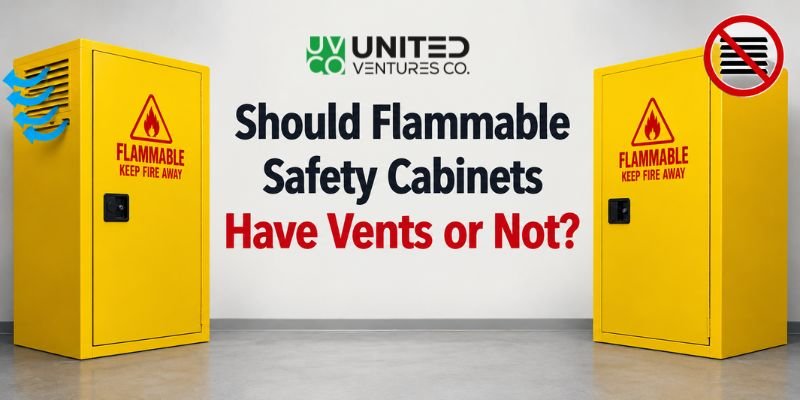
Should Flammable Safety Cabinets Have Vents or Not?
Flammable materials not only serve as an operational necessity, but also a potential hazard in lots of settings. From expansive manufacturing industries to bustling laboratories, these volatile substances serve important roles.
If they get mishandled in any way, it may lead to serious injuries or loss of life. In such cases, a highly robust fire cabinet seems to be a trusty guardian. It is one of the best places to properly store and isolate flammable materials from external agents.
Now, are you wondering whether your flammable safety cabinet must have vents or not? The requirement varies based on utility. Read below to come to a final conclusion.
Before that, it will be good to get insight into what flammable cabinets can store.
Do Flammable Cabinets Prevent Fire and Smoother Flames?
A flammable storage cabinet is designed exclusively for storing potentially flammable and combustible liquids. Substances having a flash point at or below 199.4 degrees F with a boiling point below 95 degrees F are flammable liquids.
It is better not to take the risk of storing such hazardous materials on an open shelf. A fire safety cabinet allows the storage of such highly combustible liquids in a container that prevents quick fires.
Some commonly stored flammable liquids in a flammable safety cabinet are:
Acetone
Benzine
Ether
Methanol
Petroleum
Fire safety cabinets are constructed specifically to prevent the early catching fire of the internal contents. They not only ensure the highest safety standards, but also permit minimizing risks of fire-related accidents.
Some of the places where these cabinets are used include:
Laboratories
Chemical manufacturing industries
Workplaces
Flammable and combustible substances can be easily ignited. That is why it is important to store them carefully. Fire cabinets manufactured using fire- or flame-proof materials help in reducing potential hazards.
Is it Safe for Fire Cabinets to Have Vents?
The need for vents in flammable storage cabinets may vary depending on the guidelines and specific regulations in the place. In some cases, vents may be helpful in ensuring proper ventilation.
Such an exclusive feature may help prevent the buildup of flammable vapors. But in a few situations, vents may not be safe for the integrity and prevention of the spread of fire.
An improperly ventilated fire cabinet may increase the risk of high susceptibility to fire. Cabinet ventilation may allow easy elimination of exposure to unwanted odors, toxins, and ignitable gases.
Ventilated fire safety cabinets are highly suitable for closed rooms having limited air circulation.
What is the Right Way to Ventilate A Fire Safety Cabinet?
Safe ventilation of a fire cabinet requires something more than removal of bungs. It must include a connection to the exhaust system of the facility. Alternatively, the connection may be vented outdoors via a blower.
Even a small blunder may lead to a dangerous accident. That is why, rather than carrying out experiments, it is good to follow local building codes. Consulting a reliable and trustworthy professional may ensure proper ventilation of our safety cabinet up to code.
As a Conclusion!
From above, it is clear that ventilation of a fire cabinet may depend on the needs and building codes. Have you been planning to install such a storage cabinet in your workplace?
Your search ends at United Venture Co With a decent collection, you will be in a favorable position to make the right choice.